
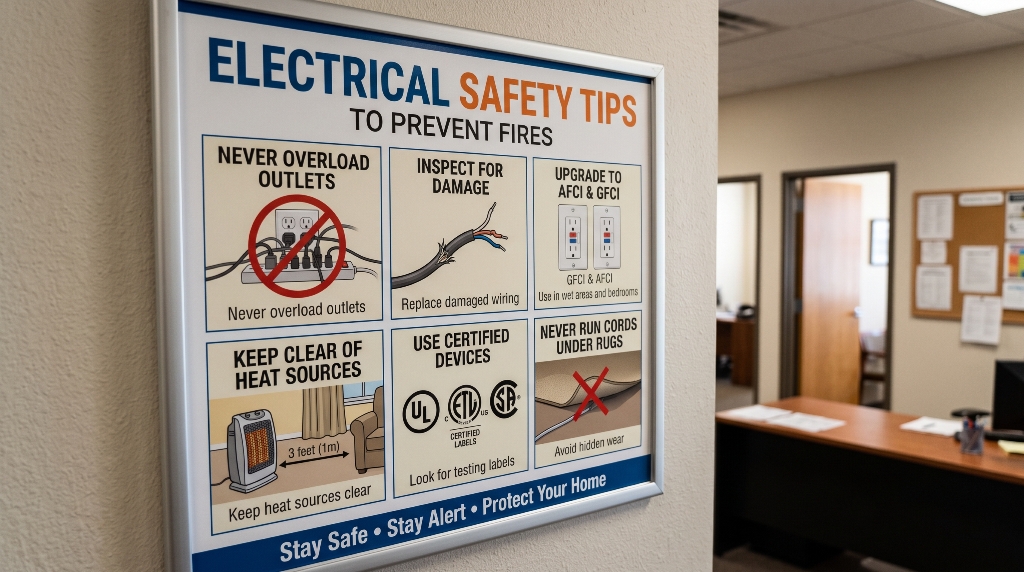
Electrical fires are often caused by hidden wear, overloaded circuits, or misused appliances. Adhering to the following core safety practices will significantly mitigate electrical fire hazards in residential and commercial environments:
Circuit & Load Management
- Never overload outlets or daisy-chain power strips. Avoid plugging high-draw appliances (space heaters, microwave ovens, refrigerators) into extension cords or power strips; plug them directly into dedicated wall outlets.
- Match breaker ratings to wire gauge. Verify that circuit breakers are properly sized for the conductor capacity (15 A for 14 AWG wire, 20 A for 12 AWG wire). Over sized breakers will not trip before the wire insulation breaks down from heat.
- Inspect panel balance and temperature. Thermal imaging or physical inspection of the breaker panel can reveal loose bus connections or unbalanced phase loads, both of which cause localized overheating.
Inspection & Maintenance
- Replace damaged wiring immediately. Discard cords or appliance wiring with frayed insulation, pinched jackets, or exposed conductors. Never run cords under carpets or through doorways where foot traffic can break inner copper strands.
- Address warm switches or discolored outlets. Outlets or switches that feel warm to the touch, exhibit buzzing sounds, or show scorching indicate dangerous arcing or loose terminal screws. De-energize the circuit at the breaker before investigating.
- Ensure tight terminal connections. High-resistance connections create hot spots. Tighten all lug and screw connections on receptacles, switches, and distribution panels to specified torque limits.
Protective Equipment & Upgrades
- Install Arc-Fault Circuit Interrupters (AFCIs). AFCIs detect dangerous electrical arcing – the primary cause of electrical fires – that standard thermal-magnetic breakers miss. Install AFCI protection on bedroom and living space circuits per current NEC standards.
- Implement Ground-Fault Circuit Interrupters (GFCIs). Place GFCI protection in wet or damp locations (kitchens, bathrooms, outdoors, basements) to prevent ground faults and shock hazards.
- Upgrade legacy wiring systems. Knob-and-tube wiring or ungrounded aluminum branch-circuit wiring (common in 1960s–1970s builds) require specialized remediation (e.g., CO/ALR rated devices or COPALUM crimp connections) to prevent oxidation-induced overheating.
Operational Safety
- Use correctly rated lamps and fixtures. Never exceed the maximum wattage stamped on a light fixture. Over sized bulbs generate excess heat that degrades socket insulation over time.
- Maintain clearance around heat sources. Keep flammable materials, curtains, and paper at least 3 feet away from portable space heaters, transformers, and high-wattage lighting fixtures.
- Verify equipment testing labels. Ensure all installed appliances, power strips, and electrical components carry recognized NRTL certification (e.g., UL, ETL, CSA).
Schedule an electrical inspection this month.